
Note
Go to the end to download the full example code.
SIP-04 Import
The SIP04 spectral induced polarization system (Zimmermann et al., 2008 Meas. Sci. Technol. 19 105603, https://iopscience.iop.org/article/10.1088/0957-0233/19/10/105603) exports data as a .mat file and as .csv files. The ‘import_sip04’ function can load both types.
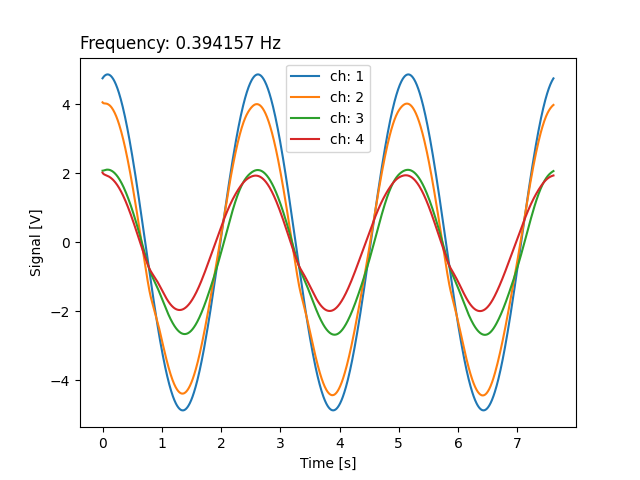
For detailed analysis of measured data, the raw time series, as measured by the system, can also be loaded.
Create the SIP container
import reda
sip = reda.SIP()
Import the SIP data
sip.import_sip04('sip_data.mat')
Import SIP04 data from .mat file
Summary:
          a     b     m     n
count  22.0  22.0  22.0  22.0
mean    1.0   4.0   2.0   3.0
std     0.0   0.0   0.0   0.0
min     1.0   4.0   2.0   3.0
25%     1.0   4.0   2.0   3.0
50%     1.0   4.0   2.0   3.0
75%     1.0   4.0   2.0   3.0
max     1.0   4.0   2.0   3.0
show the data
<class 'pandas.core.frame.DataFrame'>
    a  b  m  n  frequency             r       rpha
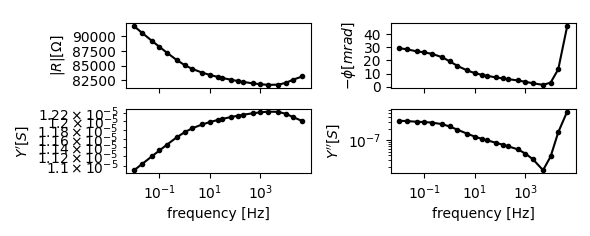
0   1  4  2  3       0.01  91710.822743 -29.362558
1   1  4  2  3       0.02  90636.299943 -28.489816
2   1  4  2  3       0.05  89244.733614 -26.907518
3   1  4  2  3       0.10  88216.019214 -26.126560
4   1  4  2  3       0.20  87199.203662 -25.008222
5   1  4  2  3       0.50  85920.509490 -22.469295
6   1  4  2  3       1.00  85104.832528 -19.333149
7   1  4  2  3       2.00  84452.492098 -15.902216
8   1  4  2  3       5.00  83819.335016 -12.312403
9   1  4  2  3      10.00  83432.605700 -10.303340
10  1  4  2  3      20.00  83104.178605  -8.858852
11  1  4  2  3      30.00  82930.728765  -8.257339
12  1  4  2  3      70.00  82606.356388  -7.006607
13  1  4  2  3     130.00  82389.613467  -6.253892
14  1  4  2  3     200.00  82254.030100  -5.743527
15  1  4  2  3     500.00  82000.383966  -4.723193
16  1  4  2  3    1000.00  81852.442931  -3.658800
17  1  4  2  3    2000.00  81744.531873  -2.586255
18  1  4  2  3    5000.00  81779.213925  -1.349227
19  1  4  2  3   10000.00  82085.647708  -3.090301
20  1  4  2  3   20000.00  82641.939514 -13.275897
21  1  4  2  3   45000.00  83175.799742 -45.989948
plot the spectrum
save data to ascii file
sip.export_specs_to_ascii('frequencies.dat', 'data.dat')

# optionally:
# install ccd_tools: pip install ccd_tools
# then in the command line, run:
#   ccd_single  --plot --norm 10
from reda.importers.fzj_readbin import fzj_readbin
import matplotlib.pylab as plt
obj = fzj_readbin('data2/sip_data.bin', sip04=True)
freq_id = 15
frequency = obj.frequencies[freq_id]
times = obj.get_sample_times(frequency)
fig, ax = plt.subplots()
for channel in range(0, 4):
    ax.plot(times, obj.data[0][channel, :], label='ch: {}'.format(channel + 1))
    # break
ax.set_title(
    'Frequency: {} Hz'.format(frequency),
    loc='left',
)
ax.legend()
ax.set_ylabel('Signal [V]')
ax.set_xlabel('Time [s]')
# fig.savefig('sip04_time_series.jpg', dpi=300)
Text(0.5, 23.52222222222222, 'Time [s]')